
Achat Sha'alti
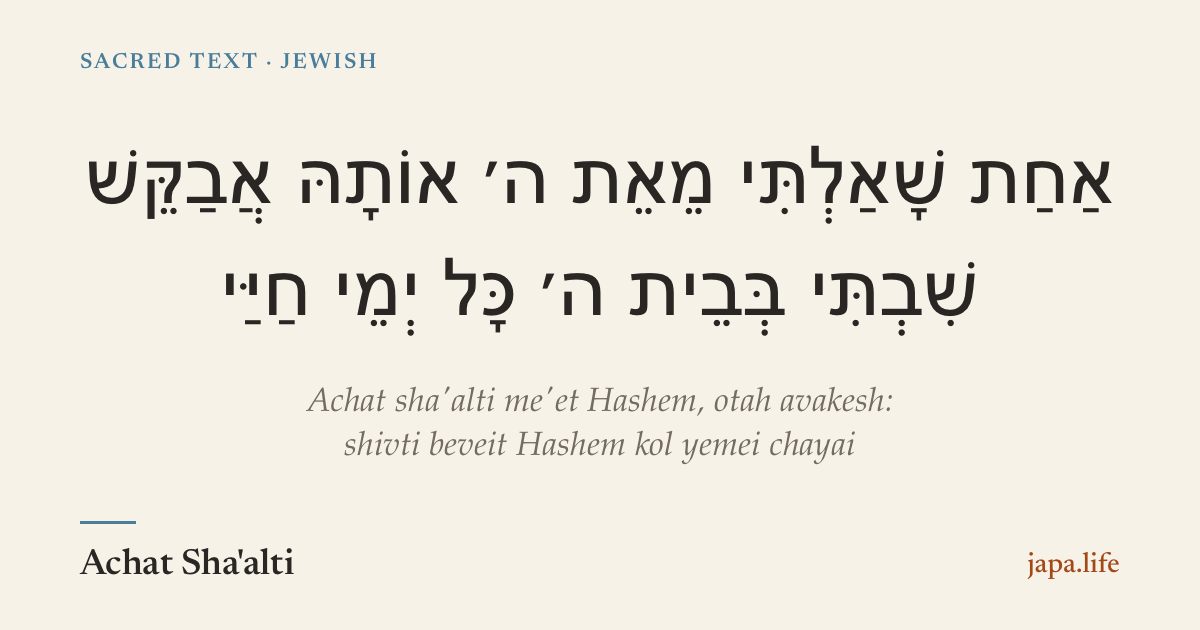
One thing I ask of the Lord, this I seek: to dwell in the house of the Lord all the days of my life
אַחַת שָׁאַלְתִּי מֵאֵת ה' אוֹתָהּ אֲבַקֵּשׁ שִׁבְתִּי בְּבֵית ה' כָּל יְמֵי חַיַּי
Achat sha'alti me'et Hashem, otah avakesh: shivti beveit Hashem kol yemei chayai
An excerpt from Psalm 27:4. Many communities add the full psalm to their prayers during Elul and the autumn festivals; the displayed words are only part of one verse.
Source: Psalm 27:4
The count shown here is Japa's suggestion, not a rule of the tradition. Follow the form and number you were taught.
Not counted on beads
How many times
Japa suggests twice a day. Follow the number you were taught.
Japa counts this one without a mala: a plain daily number rather than a ring of beads, with the words kept in view while you say them. Counting is unlimited and free.
Open this practice in JapaOpens a preview of this practice, with an option to add it in Japa 1.6 or later. If you install the app, return here and open the link again.
What the words say
Achat sha'alti: one thing I have asked. Otah avakesh: that is what I seek. The request itself is not rescue or relief: shivti beveit Hashem kol yemei chayai, to dwell in God's house all the days of my life. Asking for one thing, and then asking for presence rather than outcome, is the whole shape of the verse.
Where it comes from
Psalm 27:4. The custom of reciting Psalm 27 twice daily from the start of Elul through Hoshana Rabbah is widespread but not universal, and communities differ on the start and end dates.
How it is practised
The goal of two reflects a twice-daily custom for the full psalm, on separate occasions. Repeating this excerpt alone is an optional app practice, not a substitute for that liturgy.
References
- Psalm 27:4
- Elul custom of Psalm 27; start and end dates vary by community
Keep it, and count it every day.
Japa keeps this text beside a large, calm counter on iPhone, iPad and Apple Watch, with a haptic for every bead and an optional bell at the end of each round. Counting is unlimited and free.
In Japa this practice is kept with Elul. Adding the observance brings it to Today for as long as it runs, and withdraws it when it ends. Browsing every observance is free; adding one to Today is part of Japa Lifetime.
Get Japa on the App Store